
You’ll recoup your investment in 5-7 years by choosing high-efficiency models exceeding 23% that charge multiple devices simultaneously. Look for panels with N-type technology, bifacial capabilities, and universal 5-in-1 cables compatible with major power stations. Prioritize durability with IP65+ ratings and ETFE lamination for longevity. Weight matters too—lighter options under 10 lbs suit camping and travel better. The right combination of efficiency, compatibility, and weather resistance modifies these panels into genuine profit generators. Identify which specific models deliver the best returns.
| 100W Portable Solar Panel with 5-in-1 Cable |  | Best Universal Compatibility | Power Output: 100W | Conversion Efficiency: 23.5% | Weight: 9.48 lbs | VIEW LATEST PRICE | Read Our Analysis |
| Renogy 200W Portable Foldable Solar Panel Charger |  | Best Efficiency Rating | Power Output: 200W | Conversion Efficiency: 25% | Weight: 13.89 lbs | VIEW LATEST PRICE | Read Our Analysis |
| VEVOR 100W Bifacial Foldable Solar Panel Charger |  | Best Bifacial Technology | Power Output: 100W | Conversion Efficiency: ≥24% | Weight: Not specified | VIEW LATEST PRICE | Read Our Analysis |
| 200W Portable Solar Panel for Power Stations |  | Best Overall Performance | Power Output: 200W | Conversion Efficiency: 23.5% | Weight: 18.96 lbs | VIEW LATEST PRICE | Read Our Analysis |
| GRECELL 200W Portable Foldable Solar Panel Charger |  | Best Value Option | Power Output: 200W | Conversion Efficiency: 23.5% | Weight: 17.94 lbs | VIEW LATEST PRICE | Read Our Analysis |
| N-Type 200W Portable Solar Panel for Power Stations | 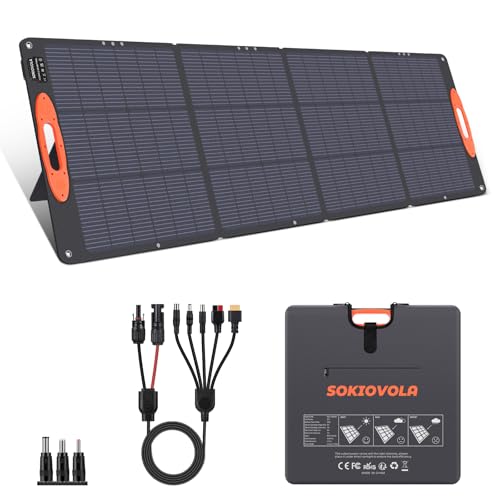 | Best Warranty Coverage | Power Output: 200W | Conversion Efficiency: 25% | Weight: 16.31 lbs | VIEW LATEST PRICE | Read Our Analysis |
| FlexSolar 100W Portable Solar Panel Charger with USB-C & USB-A |  | Most Portable Pick | Power Output: 100W | Conversion Efficiency: 23%+ | Weight: 4.1 lbs | VIEW LATEST PRICE | Read Our Analysis |
More Details on Our Top Picks
100W Portable Solar Panel with 5-in-1 Cable
If you’re looking for a solar panel that charges virtually any power station or device, this 100W portable option‘s standout feature is its universal 5-in-1 cable—compatible with 99% of power stations including Jackery, EcoFlow, Anker, and Bluetti models. You’ll appreciate the 23.5% efficiency from A+ grade monocrystalline silicon cells, which outperforms standard polycrystalline panels in low-light conditions. The adjustable kickstand lets you angle it at 45° for up to 25% more sunlight capture. At just 9.48 lbs and folding compactly, it’s perfect for camping and emergencies. Built-in USB ports enable direct device charging without a power station, while IP67 waterproofing and ETFE lamination guarantee durability.
- Power Output:100W
- Conversion Efficiency:23.5%
- Weight:9.48 lbs
- Water Resistance Rating:IP67
- USB Charging Ports:1x USB-C, 2x USB-A
- Foldable Design:24.13 x 21.06 x 1.77 inches
- Additional Feature:45° adjustable kickstand angles
- Additional Feature:Built-in intelligent controller
- Additional Feature:Zippered pocket for cables
Renogy 200W Portable Foldable Solar Panel Charger
The Renogy 200W stands out for adventurers and remote workers who won’t compromise on charging capacity in tight spaces. Its 16BB N-Type cells deliver 25% efficiency, outperforming standard panels while balancing just 13.89 lbs. You’ll charge three devices simultaneously using USB-C PD (45W) and two USB-A ports, supporting smartphones, laptops, and 12V battery systems. The quadfold design folds to compact dimensions with magnetic closures, four kickstands, and three-angle adjustment (40°/50°/60°) for ideal positioning. Built for durability, it’s IP65-rated and UL 61730 certified, making it reliable for RVs, SUVs, marine applications, and emergency backup power.
- Power Output:200W
- Conversion Efficiency:25%
- Weight:13.89 lbs
- Water Resistance Rating:IP65
- USB Charging Ports:1x USB-C (45W), 2x USB-A (18W & 15W)
- Foldable Design:23.72 x 22.99 x 1.97 inches
- Additional Feature:Magnetic closure for setup
- Additional Feature:3-angle adjustment positioning
- Additional Feature:UL 61730 certified
VEVOR 100W Bifacial Foldable Solar Panel Charger
VEVOR’s 100W Bifacial Foldable Solar Panel Charger stands out for outdoor enthusiasts who need reliable, portable power generation. You’ll appreciate its 16BB N-type monocrystalline cells providing ≥24% conversion efficiency, capturing both direct and reflected sunlight for superior output. The compact foldable design fits easily into your backpack for camping, hiking, or RV excursions. You can simultaneously charge multiple devices through 2 USB-A (QC 3.0), 1 Type-C, and 1 DC port. The included MC4 cable and 3-in-1 connector cable simplify setup. With IP65 weather resistance and operation from 14°F to 149°F, you’ll maintain consistent performance across demanding conditions.
- Power Output:100W
- Conversion Efficiency:≥24%
- Weight:Not specified
- Water Resistance Rating:IP65
- USB Charging Ports:2x USB-A (QC 3.0), 1x USB-C, 1x DC
- Foldable Design:Compact folding design (size not specified)
- Additional Feature:Bifacial rear light capture
- Additional Feature:10-in-1 DC connector adapter
- Additional Feature:Temperature range 14°F-149°F
200W Portable Solar Panel for Power Stations
You’ll want this 200W portable solar panel if you’re seeking a lightweight, genuinely versatile charging solution for power stations and mobile devices alike. Its 23.5% efficiency rating surpasses standard panels, converting sunlight into usable energy even during cloudy conditions. The 5-in-1 cable connects seamlessly to Jackery, Bluetti, EcoFlow, and Anker systems, while built-in USB-A and USB-C ports charge phones and tablets directly. Balancing just 18.96 lbs, it folds into a briefcase-sized package with magnetic handles for transport. Adjustable kickstands tilt up to 45°, enhancing output by 25-30%. IP67 waterproofing and industrial-grade ETFE coating guarantee durability across camping and marine environments.
- Power Output:200W
- Conversion Efficiency:23.5%
- Weight:18.96 lbs
- Water Resistance Rating:IP67
- USB Charging Ports:1x USB-A (QC 3.0), 1x USB-C (60W)
- Foldable Design:25 x 21.06 x 1.97 inches
- Additional Feature:Magnetic handles for transport
- Additional Feature:25-30% more energy capture
- Additional Feature:30-day money-back guarantee
GRECELL 200W Portable Foldable Solar Panel Charger
If you’re seeking a solar solution that doesn’t sacrifice performance for portability, GRECELL’s 200W panel delivers impressive 23.5% conversion efficiency through monocrystalline silicon cells and 6-layer ETFE lamination—outperforming comparable panels by 4% and conventional polysilicon alternatives by 1.2 times. You’ll appreciate its IP65 waterproof rating and durable 840D Oxford cloth exterior, which withstand demanding weather conditions. The foldable design compresses to a quarter of its size, weighing merely 17.94 lbs, making it perfect for camping trips. Four adjustable kickstands enable rapid setup, while the included 4-in-1 cable guarantees compatibility with 95% of power stations and various 12V batteries.
- Power Output:200W
- Conversion Efficiency:23.5%
- Weight:17.94 lbs
- Water Resistance Rating:IP65
- USB Charging Ports:Not specified for direct charging
- Foldable Design:25.82 x 21.1 x 2.95 inches
- Additional Feature:6-layer ETFE lamination
- Additional Feature:840D Oxford cloth exterior
- Additional Feature:Waterproof cable bag included
N-Type 200W Portable Solar Panel for Power Stations
The N-Type 16BB 200W Portable Solar Panel stands out as the ideal choice for anyone who needs reliable solar charging on the go. You’ll appreciate its 25% conversion efficiency, powered by A+ grade monocrystalline silicon cells that deliver impressive performance in various conditions. At 16.31 pounds with a compact 21 x 23-inch folded size, you can transport it effortlessly to RV trips, camping escapades, or off-grid locations. The IP68 rating keeps your investment protected against water and dust. You’re getting compatible connectors for Jackery, Bluetti, Ecoflow, and Anker power stations. Plus, you’ll receive a 24-month warranty and 30-day refund guarantee, ensuring peace of mind.
- Power Output:200W
- Conversion Efficiency:25%
- Weight:16.31 lbs
- Water Resistance Rating:IP68
- USB Charging Ports:Not specified
- Foldable Design:21 x 23 inches folded
- Additional Feature:4 RV mounting attachment holes
- Additional Feature:24-month warranty coverage
- Additional Feature:12-hour customer support response
FlexSolar 100W Portable Solar Panel Charger with USB-C & USB-A
Expedition seekers and emergency preparedness enthusiasts will appreciate FlexSolar’s 100W portable solar panel charger—a lightweight powerhouse designed for situations where grid access isn’t an option. Balancing at just 4.1 lbs, it folds compactly yet unfolds to capture maximum sunlight efficiently. You’ll get 45W USB-C PD3.0, 18W USB-A QC3.0, and 100W DC outputs simultaneously. The monocrystalline silicon construction delivers over 23% energy conversion efficiency. IP67 waterproof and dustproof ratings protect against harsh camping and hiking conditions. The included 4-in-1 charging cable connects seamlessly to various devices and power banks, making it your essential outdoor companion.
- Power Output:100W
- Conversion Efficiency:23%+
- Weight:4.1 lbs
- Water Resistance Rating:IP67
- USB Charging Ports:1x USB-A (18W), 1x USB-C (45W PD)
- Foldable Design:12.99 x 10.43 x 2.17 inches
- Additional Feature:100W DC output capability
- Additional Feature:0.59 inches slim profile
- Additional Feature:4-in-1 charging cable included
Factors to Consider When Choosing Solar Panels
When you’re selecting solar panels, you’ll want to evaluate power output and wattage to match your energy needs, then compare efficiency ratings and technology types to see which delivers the best performance. You should also assess portability and weight if you’re buying portable units, and verify that connector compatibility works with your existing devices. Finally, you’ll need to examine durability and weather resistance to guarantee your panels withstand the elements and deliver long-term value.
Power Output And Wattage
Since you’ll want your solar panel system to meet your specific energy needs, understanding wattage is vital. Power output directly determines how much electricity your panels generate from sunlight.
A 100W panel suits small electronics and low-wattage devices like lights and fans. If you’re powering larger appliances such as refrigerators or multiple electronics simultaneously, you’ll need 200W panels or higher for adequate performance.
However, wattage alone doesn’t tell the complete story. You must also evaluate conversion efficiency, which ranges from 16% to over 25%. Higher efficiency panels deliver better performance, particularly during cloudy conditions or low-light situations.
When selecting panels, weigh both peak wattage and overall efficiency together. This combination guarantees your system generates sufficient power to match your household’s actual energy demands and maximizes your investment’s long-term value.
Efficiency And Technology Type
You’ll want to prioritize efficiency and technology type alongside wattage, as they’re the true drivers of your solar panel’s real-world performance. High-efficiency monocrystalline panels exceed 23% conversion rates, altering more sunlight into usable electricity. N-type cells with 16BB technology push efficiency to 25% and perform exceptionally well under shading conditions, outperforming traditional polycrystalline options. Bifacial panels enhance energy generation in reflective environments and low-light situations, maximizing your system’s output year-round.
Material composition matters equally. ETFE lamination offers superior heat resistance and light transmittance compared to PET, extending your panels’ operational lifespan. These advanced technologies cost more upfront but deliver considerably better long-term returns, making them worthwhile investments for your solar installation.
Portability And Weight Considerations
If you’re planning to use solar panels for camping, RVing, or off-grid excursions, mass and portability become critical factors in your selection. Lighter panels with a mass of around 4.1 lbs are markedly easier to transport than heavier alternatives.
Foldable designs enhance portability by reducing storage footprint to less than 2 inches thick when collapsed. Built-in carrying handles or bags simplify transportation between locations, while adjustable kickstands enable quick setup and ideal sun positioning in various environments.
Don’t overlook durability when prioritizing portability. Panels rated for waterproof and dustproof protection guarantee reliable performance across diverse outdoor conditions, preventing damage during transport and use. This combination of lightweight construction, compact folding capability, and weather resistance assures you’ll have dependable power wherever your excursions take you.
Connector Compatibility And Versatility
Choosing a solar panel with the right connectors matters more than you might think, as incompatible connections can render even high-quality panels useless with your existing power stations and devices. You’ll want to prioritize panels featuring multiple charging cables or 5-in-1 universal connectors that accommodate XT60, Anderson, DC5521, and DC7909 standards—the most common formats in power stations. Direct USB-C or USB-A charging ports add extra versatility, letting you charge smartphones and tablets without additional adapters. Built-in multi-connector cables streamline setup and enhance efficiency. Ideally, select a panel compatible with at least 90% of available power stations, reducing your need for extra adapters and maximizing usability across different applications and brands.
Durability And Weather Resistance
Since solar panels face constant exposure to the elements, investing in models with strong weather resistance directly impacts their longevity and performance reliability. You’ll want to prioritize panels with IP65 or IP67 ratings, which guarantee protection against dust and water intrusion.
Look for ETFE lamination instead of traditional PET materials—it offers superior heat resistance and light transmittance for better durability. Your panels should withstand heavy rain and splashes without performance degradation.
Temperature versatility matters too. Choose panels engineered to operate efficiently across a wide range, typically from 14°F to 149°F, ensuring consistent performance regardless of climate conditions.
Finally, verify strict certifications like UL 61730, CE, and RoHS compliance. These standards guarantee enhanced safety ratings and extended lifespan, protecting your investment long-term.
Direct Charging Port Options
Beyond the panel’s structural durability, you’ll want to examine the charging infrastructure built directly into your solar system. Direct charging ports fundamentally determine how efficiently you’ll power your devices. Look for panels offering USB-A, USB-C, and DC outputs, which provide versatility for simultaneous multi-device charging during outdoor activities and emergencies.
You’ll benefit from smart charging technology supporting fast protocols like QC3.0 or PD3.0, dramatically improving smartphone charging speeds. However, verify each port’s maximum wattage output—varying power deliveries affect device compatibility and charging performance.
Prioritize panels with multiple charging ports, enabling you to charge several devices simultaneously without adapters. Additionally, confirm that ports feature IP-rated protection (IP67 or IP65 standards), safeguarding them against dust and water exposure in harsh outdoor conditions.
Frequently Asked Questions
How Long Does It Typically Take for Solar Panels to Pay for Themselves Through Energy Savings?
You’ll typically see your solar panels pay for themselves in 6 to 12 years through energy savings. Your specific timeline depends on several factors: your location’s sunlight exposure, your current electricity rates, installation costs, and available tax incentives. You’re likely to benefit from federal tax credits and state rebates that greatly reduce upfront expenses. Once you’ve recouped your investment, you’ll enjoy decades of virtually free electricity, making solar a smart long-term financial decision.
What Is the Lifespan and Warranty Coverage of Modern Residential Solar Panel Systems?
You’ll find that modern residential solar panels typically last 25-30 years, with many manufacturers guaranteeing 80-90% efficiency after 25 years. You’re usually covered by two warranties: product warranties (10-12 years) protecting against defects, and performance warranties (25 years) ensuring your system generates expected electricity. You should verify specific terms with your installer, as coverage varies by manufacturer. Proper maintenance helps you maximize these timeframes and protect your investment.
Do Solar Panels Work Effectively During Cloudy Weather or Winter Months?
Yes, you’ll still generate electricity during cloudy weather and winter months, though your output decreases. You’re looking at roughly 25% of peak production on overcast days since panels capture diffuse light, not just direct sunlight. Winter reduces your efficiency further due to shorter daylight hours and lower sun angles. However, you’ll continue producing renewable energy year-round. Modern panels perform reasonably well in less-than-ideal conditions, ensuring you’re generating power consistently throughout seasons.
Are There Tax Credits or Rebates Available for Installing Solar Panels in 2026?
Yes, you’ll benefit from substantial tax incentives. The federal Investment Tax Credit (ITC) lets you deduct 30% of your installation costs from your federal taxes. Many states offer additional rebates and incentives that reduce upfront expenses. You should check your local utility company’s programs too—they often provide rebates for renewable energy adoption. These incentives greatly enhance your return on investment, making solar panels more affordable and helping you recoup costs faster.
How Does Net Metering Work and Can It Reduce My Electricity Bills?
Net metering lets you send excess solar energy back to the grid and receive credits on your electricity bill. When your panels produce more power than you’re using, the utility company credits you at the retail electricity rate. During nighttime or cloudy days, you’ll draw power from the grid and use those credits. You’ll dramatically reduce your electricity bills since you’re fundamentally getting paid for your surplus energy production.

Leave a Reply