
You’ll traverse trails confidently with maps built on durability, precision, and proven features experienced hikers depend on. The Military Style MGRS/UTM Coordinate Grid Reader Protractor offers lightweight portability with multiple scales, while the Hubbard Scientific 3D Relief Map provides tactile elevation understanding. You shouldn’t overlook essential factors like scale accuracy, weather resistance, and visual clarity when selecting your ideal map. Uncover which topographic solutions truly match your hiking goals and terrain demands.
| Military Style MGRS/UTM Coordinate Grid Reader Protractor | 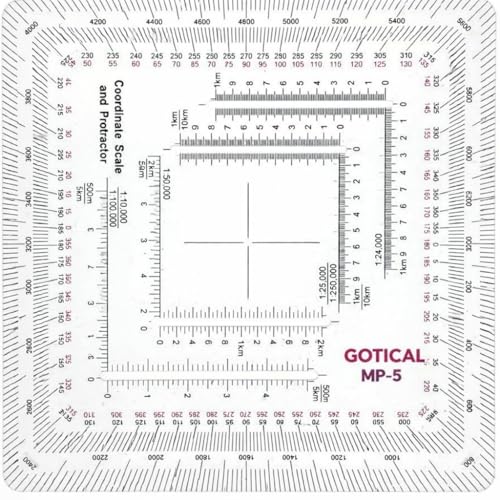 | Hiker’s Navigation Essential | Primary Use: Map reading and land navigation | Format: Handheld tool/protractor | Scale Coverage: 1:24,000, 1:50,000, and 1:100,000 | VIEW LATEST PRICE | Read Our Analysis |
| Hubbard Scientific 3D United States Ranger Relief Map |  | Visual Learning Showpiece | Primary Use: Geographical visualization and education | Format: 3D raised relief map | Scale Coverage: True-to-scale representation of USA | VIEW LATEST PRICE | Read Our Analysis |
| World Ocean Floor Topographic Map Educational Poster |  | Classroom Reference Standard | Primary Use: Marine geography education and wall display | Format: Flat poster print | Scale Coverage: Global projection with ocean basins | VIEW LATEST PRICE | Read Our Analysis |
More Details on Our Top Picks
Military Style MGRS/UTM Coordinate Grid Reader Protractor
If you’re serious about backcountry wayfinding, you’ll want a Military Style MGRS/UTM Coordinate Grid Reader Protractor in your pack. This credit-card-thin tool measures 4.75 inches square and features a durable plastic construction that’s 33% thicker than standard military issue. You’ll appreciate the rounded corners that resist pocket wear. The protractor includes multiple scale options—1:24,000 for USGS 7.5 minute topos, plus 1:50,000 and 1:100,000 rulers for broader map coverage. Its enhanced durability prevents bending or breaking during demanding wayfinding scenarios, making it an essential companion for serious hikers maneuvering through complex terrain.
- Primary Use:Map reading and land navigation
- Format:Handheld tool/protractor
- Scale Coverage:1:24,000, 1:50,000, and 1:100,000
- Material Composition:Durable plastic with protective coating
- Dimensions:4.75 x 4.75 inches
- Color Scheme:Standard printed colors (not specified)
- Additional Feature:33% thicker than military issue
- Additional Feature:Rounded corners prevent pocket wear
- Additional Feature:Multiple scale options included
Hubbard Scientific 3D United States Ranger Relief Map
The Hubbard Scientific 3D United States Ranger Relief Map stands out for hikers who want to study terrain before hitting the trail. You’ll appreciate its tactile, raised relief design that lets you feel elevation changes and topography with your fingertips. The Map Shop crafted this true-to-scale map using high-quality vinyl and hand-vacuum forming, ensuring durability and accuracy. With over 30 years of experience and 100,000+ maps shipped, they’ve perfected their process. The lively, satellite-based color scheme against a white background makes it both an educational tool and decorative piece. You’re getting functional planning assistance and visual appeal combined.
- Primary Use:Geographical visualization and education
- Format:3D raised relief map
- Scale Coverage:True-to-scale representation of USA
- Material Composition:High-grade rigid vinyl
- Dimensions:Not specified
- Color Scheme:Natural satellite-based multi-color with white background
- Additional Feature:Hand vacuum formed custom molds
- Additional Feature:Tactile raised relief experience
- Additional Feature:30+ years manufacturing expertise
World Ocean Floor Topographic Map Educational Poster
While you’re planning your next hiking expedition, don’t overlook how a World Ocean Floor Topographic Map Educational Poster can enhance your understanding of Earth’s geological structure. This 24 x 42-inch print reveals underwater mountain ranges, tectonic plates, and ocean basin formations that directly influence continental topography you’ll encounter on trails. The lively blue and yellow color scheme provides exceptional clarity, making it easy to identify major underwater features and their relationship to surface geography. You’ll gain priceless insight about plate tectonics and seafloor spreading, deepening your appreciation for the terrains you investigate. Display it in your home or office for ongoing reference before tackling challenging terrain.
- Primary Use:Marine geography education and wall display
- Format:Flat poster print
- Scale Coverage:Global projection with ocean basins
- Material Composition:Premium quality poster paper
- Dimensions:24 x 42 inches
- Color Scheme:Vibrant blue and yellow
- Additional Feature:High-resolution ocean floor details
- Additional Feature:Vibrant blue/yellow color contrast
- Additional Feature:Global projection all continents
Factors to Consider When Choosing Topographic Maps
When you’re selecting a topographic map for hiking, you’ll want to evaluate the scale and accuracy to guarantee you’re getting the detail level your trail requires. You should also consider the material’s durability, since you’ll be carrying it through various weather conditions and terrain. Finally, think about your map type preference, intended use, and visual clarity features—all of which directly impact how easily you’ll maneuver and stay on course.
Scale And Accuracy
Because you’ll traverse terrain with greater confidence when you understand map scale, it’s important to recognize how this ratio between map distance and ground distance directly affects your hiking experience. A 1:24,000 scale map reveals considerably more detail than a 1:100,000 scale, making it essential for guiding challenging trails where precision matters.
Accuracy determines whether you can trust the contours and elevation lines representing terrain features. Inaccurate maps compromise your guidance reliability and safety. You’ll benefit most from maps featuring established benchmarks and standardized symbols that meet high accuracy standards.
Consider your specific hiking needs when selecting a map. Day hikes on well-marked trails may require less detail, while backcountry expeditions demand larger-scale maps with precise elevation data. Matching scale to your activity guarantees you’ll access the geographical information you actually need.
Material Durability
Once you’ve selected a map with appropriate scale and accuracy, you’ll want to contemplate how well it’ll withstand the rigors of outdoor use. Plastic stock and high-grade vinyl materials outperform traditional paper, offering superior resistance to bending and breaking. Thicker materials—exceeding standard military specifications—better endure wear and tear during frequent handling.
Protective coatings greatly enhance your map’s longevity by repelling moisture and dirt, extending its usability in challenging conditions. Some topographic maps feature raised relief, which improves readability while simultaneously strengthening the overall structure, making them less susceptible to damage from physical interactions.
When comparing options, prioritize maps constructed from durable materials with protective treatments. You’ll appreciate the investment when your map maintains color clarity and structural integrity throughout your hiking excursions.
Map Type Selection
Selecting the right topographic map requires assessing several key factors that’ll directly impact your hiking experience. You’ll need to weigh the map’s scale—whether 1:24,000, 1:50,000, or 1:100,000—since each provides different levels of detail and terrain coverage. A larger scale offers more granular information for precise guidance, while smaller scales cover broader areas.
Next, define your purpose. Are you traversing backcountry trails, planning a day hike, or studying geography? Your specific use determines which features matter most.
You should also assess how the map represents geographical features. Detailed relief patterns and contour lines enhance your understanding of elevation changes and terrain difficulty.
Finally, decide between hand-crafted and mass-produced options. Hand-crafted maps often provide superior visual appeal and tactile quality, making them indispensable for educational purposes.
Intended Use Purpose
Your hiking goals and activities shape which topographic map will serve you best. You’ll need different scales depending on your specific needs. For day hikes, a 1:24,000 scale map provides the detailed terrain features you require, showing elevation changes and trail conditions clearly. If you’re planning longer backcountry expeditions, a 1:100,000 scale map covers broader geographic areas more efficiently. Consider what information matters most to you—whether that’s precise contour lines for route planning or watershed boundaries for water source identification. Your map choice directly impacts route-finding accuracy and safety. A durable, portable map with a reliable protractor or ruler guarantees you can make precise measurements in the field. Match your map’s detail level to your hiking ambitions for peak performance.
Visual Clarity Features
When evaluating topographic maps, you’ll want to prioritize visual clarity features that make terrain details unmistakably readable. High-resolution printing guarantees you can distinguish intricate topographic features without strain. Lively color schemes effectively differentiate elevations and terrain types, while strong contrast—like blue against yellow—makes ocean depths and landmasses pop visually. You’ll find that larger map scales deliver greater detail and precision than smaller versions, essential for hiking route planning. Consider maps incorporating tactile elements, such as raised relief features, which provide multi-sensory understanding of topographical changes. These elements combine to change a flat map into an intuitive guiding tool, enhancing both safety and enjoyment on the trail.
Portability And Size
Because you’ll be carrying your map throughout your hike, portability becomes a critical factor in your selection process. Smaller dimensions make maps easier to fit into pockets or compact bags without sacrificing navigation detail. Consider compact sizes around 4.75 inches square—they enhance field usability while maintaining legibility.
Material thickness presents a trade-off you’ll need to evaluate. Thinner maps reduce weight, making them ideal for ultralight excursions, but they’re more vulnerable to damage from moisture and folding. Thicker options provide better durability and withstand repeated handling, though they add slightly more weight.
Balance these considerations based on your specific needs. Choose a map that you can easily handle in the field while fitting your pack’s constraints. The right size guarantees you’ll actually carry and reference your map throughout your expedition.
Educational Value Assessment
While selecting a map based on size and portability guarantees you’ll carry it in the field, considering its educational value determines how much you’ll gain from the expedition itself. High-resolution topographic maps with detailed contour lines help you interpret geological structures like mountains and valleys, sharpening your spatial reasoning skills. You’ll develop critical abilities to read elevation changes and identify terrain features, altering raw data into meaningful terrain understanding. This knowledge enhances your appreciation for earth sciences and improves wayfinding safety. Maps featuring tactile elements benefit diverse learners, offering hands-on engagement with complex landforms. By prioritizing educational quality alongside practical features, you’re investing in maps that educate and guide, enhancing both your hiking experiences and geological comprehension.
Long-Term Investment Quality
How do you guarantee your topographic map remains a reliable tool for years to come? You prioritize durability through high-grade vinyl or enhanced plastic construction. These materials withstand repeated folding, moisture exposure, and rugged handling that typical maps can’t endure.
Seek maps featuring protective coatings or increased thickness—they resist bending and tearing remarkably better. High-quality printing techniques enhance both visual clarity and longevity, ensuring contour lines stay sharp and readable after extended use.
Consider vacuum-formed or hand-crafted options, as they guarantee superior quality control throughout manufacturing. Maps designed with tactile engagement serve dual purposes: functional hiking tools and decorative pieces that retain value over years.
Your investment in sturdy construction pays dividends through extended usability and reliability.

Leave a Reply